


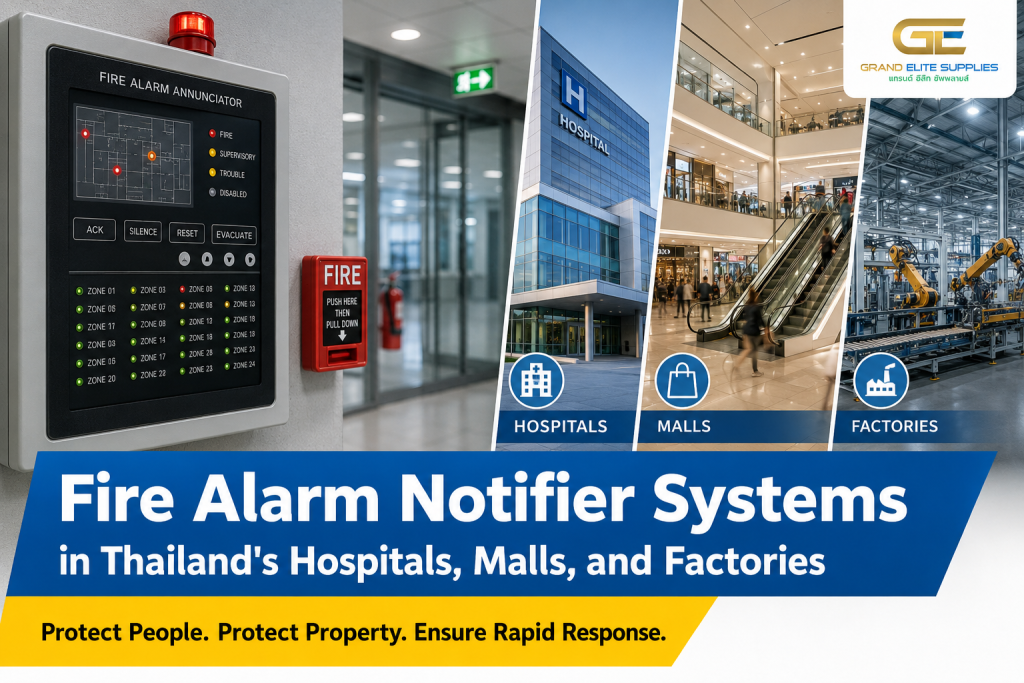
In fire protection meetings for hospitals, malls, and factories across Thailand, one name comes up again and again: NOTIFIER. Consulting engineers often write it directly into project specs rather than leaving the choice open to any brand that meets the standard, and that habit is worth understanding before you are the one signing off on a system.
A Fire Alarm Notifier system refers to fire detection and life safety equipment from NOTIFIER, a Honeywell brand. It is built as an engineered system, where panels, detectors, modules, and notification devices work together as one coordinated platform, certified to the UL and FM standards that insurers and code officials in Thailand use as their baseline.
NOTIFIER Is a Honeywell Brand Built as an Engineered System
NOTIFIER sits under Honeywell’s building technologies business, which gives it the backing of a large industrial company with decades in fire and life safety. But what makes engineers trust the name goes beyond ownership; NOTIFIER builds what the industry calls an engineered system. Rather than separate parts bought off a shelf and hoped to be compatible, every panel, detector, module, and notification device is designed and tested to operate as one platform.
This matters more than it sounds. A fire alarm system isn’t just about detecting smoke; it has to reliably tell the right people, in the right place, at the right time, and keep working when it matters most. An engineered system gives a design team more control over how zones are laid out, how devices report their location, and how the whole building responds during an actual event, rather than settling for the most generic setup available.
The Certifications That Put Fire Alarm Notifier into Project Specs
A big part of why the Fire Alarm Notifier name gets specified comes down to certification. Its products carry listings from UL (Underwriters Laboratories) and FM (FM Approvals), the independent testing bodies most insurers, code officials, and consultants in Thailand use as a baseline when approving a fire protection design, in line with the framework of the National Fire Protection Association (NFPA). Without those listings, a system might still function, but it won’t pass the review that most large commercial projects require.
This is why the brand is often named directly in a project’s terms of reference or bill of quantities instead of a generic “addressable fire alarm system, UL listed.” A track record of passing reviews smoothly reduces the risk of approval delays, which on a large project can cost far more than the equipment itself. For insurers, the listing can even affect premiums and whether a claim gets honored, which is why hospitals, malls, and factories rarely leave this to chance.
Where Fire Alarm Notifier Systems Are Actually Used in Thailand
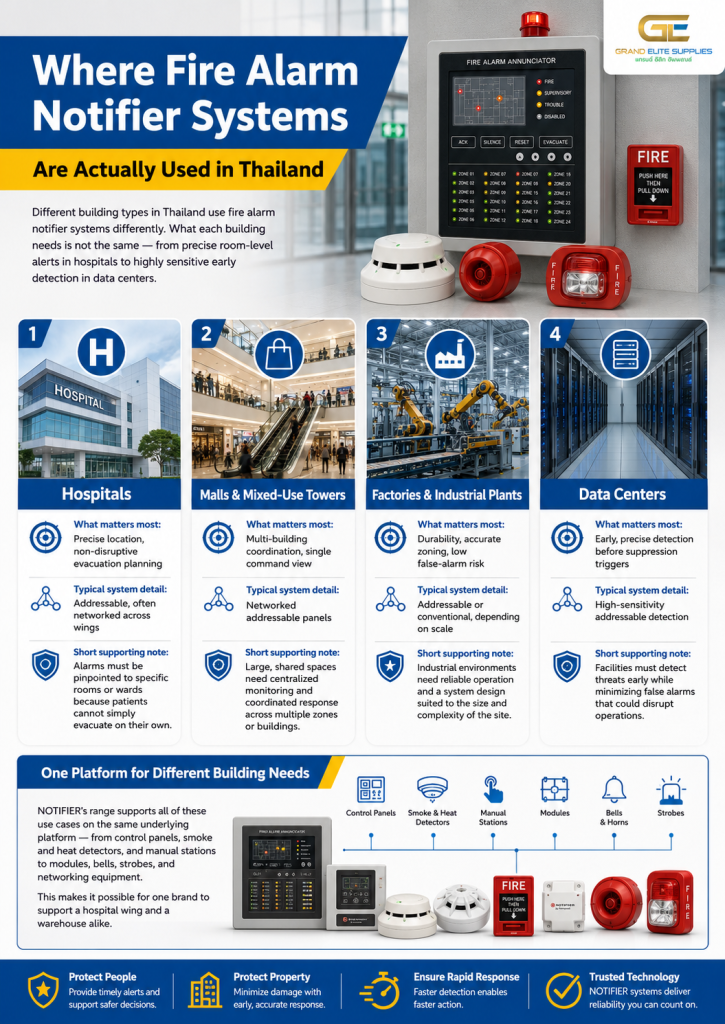
Look at how different building types in Thailand use these systems and a clear pattern emerges. What each building needs isn’t the same: a hospital has to pinpoint an alarm to a specific room because patients can’t simply walk out, while a data center worries as much about a false suppression trigger as about a missed fire. The table below sums up how those needs differ.
| Building type | What matters most | Typical system detail |
| Hospitals | Precise location, non-disruptive evacuation planning | Addressable, often networked across wings |
| Malls & mixed-use towers | Multi-building coordination, single command view | Networked addressable panels |
| Factories & industrial plants | Durability, accurate zoning, low false-alarm risk | Addressable or conventional, depending on scale |
| Data centers | Early, precise detection before suppression triggers | High-sensitivity addressable detection |
NOTIFIER’s range covers all of these cases on the same underlying platform, from control panels, smoke and heat detectors, and manual stations to modules, bells, strobes, and networking equipment, which is why one brand can cover a hospital wing and a warehouse alike.
Matching Conventional or Addressable Panels to the Building
Not every project needs the same type of panel. A conventional system reports which zone an alarm came from, which is often enough for a smaller, single-purpose building. An addressable system can report the exact device, and in many cases the exact location description programmed into it, which is what larger or more complex buildings, the hospitals and malls mentioned above, tend to require.
The right choice comes down to matching the panel’s reporting detail to how quickly and precisely the building’s response team needs to react.
| Criteria | Conventional | Addressable |
| Reports | Zone the alarm came from | Exact device and location |
| Best fit | Smaller, single-purpose buildings | Larger or multi-zone buildings |
| Expansion | Limited, zone-based | Flexible, device by device |
| Common in | Small retail, standalone shops | Hospitals, malls, factories, data centers |
For a deeper comparison of the two panel types, see our full guide on conventional vs addressable fire alarm systems.
Why Engineers Keep Specifying Fire Alarm Notifier Systems
Beyond the certifications and the building examples, there’s a simpler reason NOTIFIER keeps showing up on drawings: familiarity reduces risk on a project. Once a design team, a contractor, and a maintenance team all know how a system’s panels, protocols, and parts work, sticking with that brand across a portfolio of buildings means fewer surprises during installation, fewer compatibility issues during expansion, and an easier time sourcing parts years later when something needs replacing.
That last point is often underestimated. A fire alarm system stays with a building for decades; it gets serviced, expanded, and occasionally repaired for its whole life. A brand with a wide local supply base and a track record of parts availability in Thailand makes that long-term relationship much less painful than betting on a system with limited local support.
Sourcing NOTIFIER Systems and Parts in Thailand
The right products depend on the panel series, device count, and system design. Available Fire Alarm Notifier products may include control panels, smoke and heat detectors, manual stations, modules, bells, and strobes. Before ordering, it is important to check the model, compatibility with the current system, and current product availability.
For replacement work, photos of the existing panel, model label, connected devices, and any fault messages can help identify the parts required. For a new project, a floor plan, number of floors, and estimated device count will make it easier to prepare the product list and quotation. Grand Elite Supplies supplies NOTIFIER equipment for public and private projects, with delivery available across Thailand.
FAQ
What is the Fire Alarm Notifier brand?
NOTIFIER is a Honeywell fire detection brand built as an engineered system, with UL and FM listed products widely specified in hospitals, malls, factories, and data centers across Thailand.
Is NOTIFIER only used in large commercial buildings?
No. Its range covers small conventional setups as well as large networked, addressable systems, so it shows up in everything from single retail units to hospital campuses.
Does a NOTIFIER panel need NOTIFIER-branded detectors?
Not always, but compatibility depends on the panel series and protocol. It’s worth checking against the panel model before mixing in another brand’s devices.
What does a UL or FM listing actually guarantee?
It confirms the product met a recognized independent testing standard, which is what most insurers and code officials in Thailand check before approving a design.
Can a NOTIFIER system grow with a building as it expands?
Yes. Addressable panels in particular are built to add devices or network with other panels as a project adds floors or wings.
